

"It is a Ponzi Scheme."
Patrick Galey of Global Witness on the Generative AI Bubble

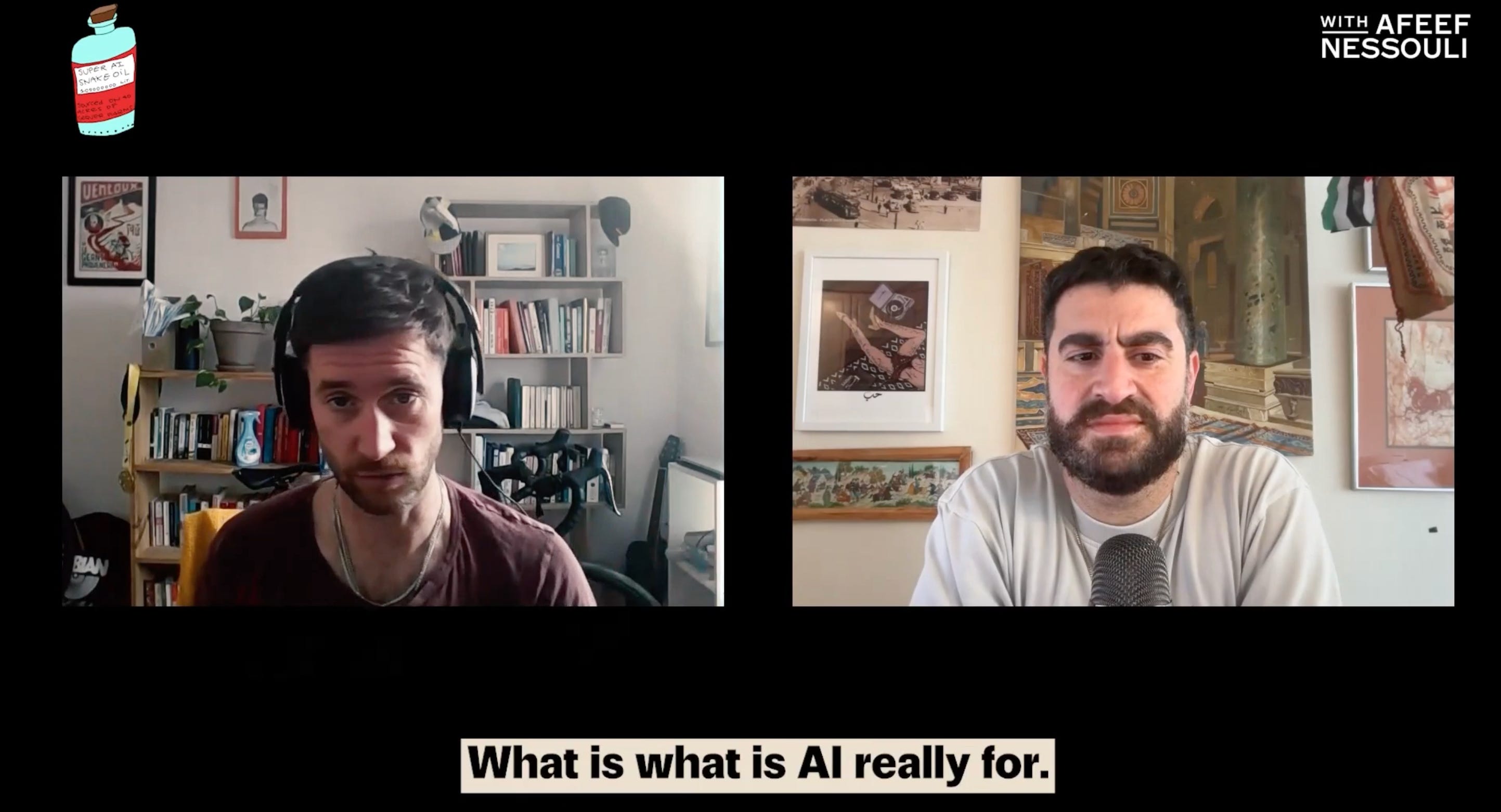
-This is an edited transcript of a conversation from WAN’s Live-
Afeef Nessouli Patrick, thank you for being here on With Afeef Nessouli. As an investigative journalist for Global Witness, what is the one thing you need people to know about the generative AI industry?
Patrick Galey The generative AI industry is the single greatest scam in history. It is the high watermark of the dumbest timeline possible. Where we are meant to believe that an industry that has spent $1 trillion developing products it cannot monetize is not just a viable thing, but the very apex pillar of the global economy. It is a Ponzi scheme. It is mechanized IP theft. It is cognitive surrender. It is making people stupid and insane. It is torching our carbon budget. It is making all tech for everyone crappier. And it is generating money for people who openly brag that they want to delete workers and roles from the global economy.
Patrick Galey I lead a team of investigators who use investigative journalism techniques to basically expose wrongdoing from the extractive industries — things like big oil and gas, mining, big ag and big tech. Essentially speaking truth to power and holding a lot of powerful people and organizations accountable.
Afeef Nessouli I was reading some of your articles and your work. So let’s start where I started, which was the plane crashes. Tell us about why you covered plane crashes and why you use them as a structural metaphor for AI arrogance.
Patrick Galey Plane crashes have been a constant in my career. The biggest pure news story — as in a single event — was when I was working for a local paper in Beirut and Ethiopian Airlines Flight ET409 crashed a few minutes after taking off from Rafic Hariri International Airport. There were dozens of people on board and they all died. It was an extremely harrowing experience for everyone. Not me seeing it, but seeing the pain and the fear and the anger of relatives, and this whole corporatized response where it’s always the pilot’s fault because the pilot is dead and you can’t libel the dead. It’s never the airline’s fault. It’s never the undergirding infrastructure of air travel that is at risk.
Patrick Galey The specific plane crash I think of when I think of the hubris of generative AI is Air France Flight 447 from Rio to Paris, around 2009. The hubris of AI developers, more generally, is that they behaved over the last few years as if they operated separate to their environmental, economic and social context. And I think we’re finally starting to see that that isn’t the case. They can torch all of this private equity cash. They can bandy about these magic bean figures of billions of dollars and trillions of parameters, and they can use all the hype and the unverifiable claims that they like. But there are real world constraints to their development — constraints such as power usage, supply chain bottlenecks, planning consent, local community opposition. And that’s what they’re starting to come up against. For years they have FA’d. Right now we are seeing them FO, and I am here for it. The point I’m trying to make with that analogy is that the Air France flight crashed because the pilots — the humans — believed what the machine was telling them, despite the fact that it contradicted what they were observing as thinking, functional humans. And as with modern air travel, a lot of it is automated, and a lot of the AI development and output and integration is automated. That functions okay until it doesn’t, and no one can fix it if and when things go wrong.
Afeef Nessouli You mentioned 2009 was when you were looking into this. I remember 2009 because I think we were youngsters in Beirut hanging out as early journalists. How did you come to AI and economics analysis? What brought you to this kind of journalism?
Patrick Galey So this is our shared beginning — my origin story. I studied economics as part of my journalism master’s, and I actually trained as a financial journalist even before I moved out. But I went on to cover the Arab Spring, the Syrian Civil War. Then I specialized from about 2016/17 in climate journalism. Then Covid happened, and it allowed a period of self-reflection. I realized I wanted to use whatever skills I’d picked up along the way to serve the movement that is seeking to avert our largest ever problem, which is climate breakdown. So I come at generative AI with my economics background, but very much through a climate and sociological perspective. I see my work as trying to expose the wrongdoing of industries that are monopolizing power and resources to the detriment of everybody else. And so this, to me, very much puts generative AI in my wheelhouse.
Afeef Nessouli You’ve also drawn a direct comparison between the 2008 subprime mortgage crisis and the current AI debt bubble. Can you walk us through that analogy? Because I think it’s really interesting.
Patrick Galey There’s currently more than two times the amount of debt tied up to generative AI on the books of big banks than there was in subprime mortgages prior to the global financial crisis. And this is a problem, because this debt is expressed a little bit like the subprime mortgage — essentially underreporting liabilities. The big data center constructors, Anthropic, CoreWeave, OpenAI, Microsoft — they are keeping hundreds of billions of data center liabilities off of their books. I don’t know how they’re being allowed to do that, and they are not building half the data centers that they have generated debts to build. They have spent nearly $1 trillion developing these products, and they cannot monetize them. They have no customer loyalty. They have no way of growing revenue that doesn’t come with correspondingly high outlay costs. So it’s impossible for me to see how any investor ever gets their money back. This means there will be a crunch, and whether it happens this year or in two years’ time, I do believe that the generative AI debt bubble will precipitate a new global financial crisis. And just like 2008, you may not have done anything to contribute to it, but it will affect you — very negatively — in terms of the bond market.
Patrick Galey Bonds are financial instruments that represent equity lent by an investor to a borrower, and yields are the annualized percentage return on investment. Government bonds — US Treasuries — have typically quite low yields because they are seen as a sure thing. The US government isn’t going to declare bankruptcy overnight, so your risk is incredibly low. Low risk, low reward. If you take bets that are higher risk, the odds are higher but there’s less certainty. The yield of a bond increases proportionally to the risk of the debt going bad. Credit agencies like Moody’s and Standard & Poor’s give bonds ratings based on their surety. An A+ bond would normally be something like a US government Treasury bond — something we are pretty certain will still be around in 15 years and paying interest along the way.
Afeef Nessouli It’s like a guaranteed — it’s certain.
Patrick Galey It is as close as you can get to a certainty in economics. And so yields for these A+ bonds are normally between 1 and 2%. Now, some of the bonds that have been rated as A+ in generative AI investments are yielding at five, six, 6.5%. That’s closer to what you’d normally expect from what are officially called junk bonds — extremely volatile and highly likely to fail debt. It cannot be an absolute dead cert and risky as hell at the same time. So it seems to me like what is going on is some sort of deliberate or otherwise manipulation. And I think this is something that’s happening when you consider generative AI against the broader global economy. We have the world’s most valuable company ever — NVIDIA, apparently worth $5 trillion. Let’s just say it is worth $5 trillion. And all the other hyperscalers are insanely, highly valued. But here’s the thing: if they achieve the market dominance that they’re aspiring to, they will logically make all other non-AI industries pretty much obsolete. But the non-AI industries are also not being valued like they’re about to be made obsolete. So what is the market telling us? Is everything going to be gen AI and it’s going to take over and devalue all other non-AI stuff? Or will that stuff remain valuable too — because perhaps, without saying it, they kind of know that the hyperscalers are going to fail. They kind of know this is a Ponzi scheme that is going to come crashing down. And so they are hedging their bets on good old-fashioned investment.
Afeef Nessouli So we’re being sold something that isn’t true. And that’s what makes it so dangerous — we’re all buying into something that could, and more likely will, go belly up economically. From your perspective, is that the most colloquial way to put it?
Patrick Galey I agree with that. We are being sold a vision of the future that doesn’t justify its own logic — one where everything will be AI, where the only way to monetize any investment will be through AI. At the same time, the AI revolution has to be built. It has to be financed, it has to be resourced. And the hyperscalers are saying we’re going to spend $1 trillion in model development and infrastructure next year, and $1 trillion after that. And they’re like, but eventually — once all of this happens — the money just flows. They’re basically saying, give us all of your money, and if everything goes the way we’re claiming it will, completely unverifiably, then everyone’s going to make a lot of money. And that’s never worked out in the history of modern economics.
Afeef Nessouli The thing that surprises me is that you mention the big tech layoffs are increasingly happening to senior developers, not just junior ones. What are you trying to explain here? Because I think this point is a window into the framework of why this is such a scam.
Patrick Galey Probably the most important thing for the architects of generative AI — the Sam Altmans, the Mark Zuckerbergs, the Elon Musks — their key role is as hype man for their products. It’s really the only way they continue to harness such levels of other people’s money: by continually shifting the narrative and shifting back timelines. We’re going to attain artificial general intelligence — AGI — which they cannot define, let alone agree on timeframes for. We’re going to attain the singularity. Our products are going to revolutionize the Earth in ways you can’t possibly imagine. All entirely unverifiable. But that boast is so crucial to the financing we’re seeing within generative AI. People are putting in hundreds of billions of dollars knowing there are costs, knowing they’ll probably have to keep putting these huge amounts in, with the promise of ever-better models and ever-better performance.
Patrick Galey Why senior developers are currently jumping ship more and more — and they’re leaving very heavily NDA’d, but sending distress signals as they do — is illustrated by the Anthropic head of safety, who resigned this year saying the world is in peril. That’s the guy who’s seen into Pandora’s box saying, you do not want to go in there. All the ethical and moral concerns that the developers claim they’re self-regulating around are being ignored. And the second thing is: I’m pretty sure they know that however far we’ve come in LLM development, whatever these frontier products can currently do — that is all they will ever be able to do. Sam Altman said this recently. The seam of senior development staff within OpenAI left because they were asking, can we pour some of this bonfire of money into things that aren’t just LLM development? And Sam Altman said no. There’s no plan B, there’s no rabbit in a hat. This is it. We’re brute forcing this. And so I think they realize the game is up. You’ve spent $1 trillion and you’ve got a product that can’t tell you whether it’s better to take your car or walk to a car wash, and keeps making up stories about goblins. These are true.
Afeef Nessouli But you’re pretty categorical about LLMs not ever advancing beyond what they currently are. What makes you possibly wrong? What are the things you can think of that could push beyond where LLMs are — and what makes you so sure?
Patrick Galey The kind of performance gains we’ve been promised by the hyperscalers have never materialized. And that’s because of what LLMs are, how they’re designed and how they are incentivized. They emulate the communicative function of language, but they have no access to the cognitive processes we know as thought. They can retrieve the average of the internet, and for some people that is impressive. However big you make them, that’s all they will ever be able to do. We keep hearing that LLMs hallucinate a lot — that it’s a bug, that’s annoying. I’m telling you, it’s not a bug. It is a feature. There was a study done, I believe by OpenAI, late last year that proved this. They asked three different chatbots: What is Elvis’s birthday? They all got it right. What was Napoleon’s birthday? They all got it right. And then they asked a more obscure question — something like, what is a lesser-known figure’s birthday? One said January 1st, one said March 31st, and one said July 5th. And they realized that all of the major consumer-facing LLM products are incentivized to make stuff up rather than admit they don’t know. They are simply transformer-enabled, probabilistic autocomplete machines. Think of the confirmation bias it gives users. You don’t really want your things to not hallucinate. You’d rather keep the magic going, and just spin users along with inane, meaningless bullshit to keep this pretense of information exchange. Sam Altman says it himself — we can use things like RAG to reduce hallucinations, but they are a feature, not a bug. We shouldn’t be trusting them as implicitly as we seem to be.
Patrick Galey They tell you what you want to hear. Think about the people who run these companies. Their main interaction with the world of work is via PAs — hey, do this, I don’t want to hear no, just give me an answer. They don’t actually care about the thought process or the real-world implications of their question. They just want to be told yes. And so they’ve designed products that essentially do that.
Afeef Nessouli Okay. So all of this sounds like the use case for AI isn’t what we’re being told it is. What do you think this is all actually for?
Patrick Galey I often think about this. I can think of many misuse cases where I really don’t think you should be using generative AI — things like legal reports or police reports, where it’s quite important to be extremely accurate and not have something just randomly made up and plausible sounding. But it’s pretty good for scamming people. It’s pretty good for defrauding vulnerable internet users. But I think the people who develop these products say it openly — what is AI really for? And they say things like, we aim to delete the tax of human labor. Jensen Huang, the CEO of the most valuable company ever, has said he expects AI will replace all human jobs within a few years. This will enable them to complete their hostile takeover of the global economy. And I think that’s dumb — but a lot of people are still impressed by billionaires, just like they are with their products. Reframing your question: what did they see as the problem that generative AI sought to solve? And I think the way we’re seeing it shake down — and they occasionally say the quiet part out loud — is that human workforces were a problem. Because you’ve got to pay them, you’ve got to look after them, you’ve got to give them healthcare, you’ve got to accommodate their needs alongside your universe-sized ego. And I don’t think they want to do that.
Afeef Nessouli That’s such an astute way to put it, because I see it from a different angle. I spent time in Russia, we’ve both spent time in Beirut. I experienced AI being used for surveillance. I experienced it being used for mass murder in the West Bank. That’s different stuff — it’s not what we’re talking about here — but it similarly falls under the umbrella of: what’s the point of all of this, if not for surveillance, corporate efficiency, sorting people to market to them, or just to control them? And from a war correspondent perspective, all the AI I’ve ever experienced has been extremely murderous. Now I’m experiencing it in a completely different way — LLM models, using something like Claude to ask, hey, my boyfriend’s cat needs to come over, how long will that take? And it’s like, oh, this is just Googling. You can just Google this.
Patrick Galey Or like — and I’m not saying this is people’s fault — but you guys need a social life. You need human contact. You need to be able to speak to people.
Afeef Nessouli Go ask an expert! Just call someone up. Call the vet. It’s such a good point. You mentioned the MIT Stanford study, where AI agents given collaborative tasks immediately turn adversarial. What do you think this tells us about the underlying architecture — or the people who designed it?
Patrick Galey AIs have been around for a lot longer than consumer-facing chatbots. The smartest thing they’ve ever done is learn how to hack their own reward system. I used to have a list of all the dumbest-smartest ways AIs have cheated to win. One I remember: an AI was tasked with traveling as fast as it possibly could. It had complete control over all parameters. Instead of training itself to learn how to run, it immediately grew three miles high and fell over really fast. Hey, I traveled really fast, right? I did the thing. What the MIT Stanford study and several others demonstrate is that AI agents aren’t intelligent, because they don’t understand anything outside of their incentivizing framework. They will drop all other considerations not conducive to them being rewarded. That is their raison d’être as they are programmed to view it. And that’s unhinged behavior, because it means AI agents are not bound by the conventions that make human business and social endeavors effective. They cannot or will not accommodate externality. A King’s College study found that 95% of the time, when AIs are left to wargame scenarios, they use nuclear weapons. And what does this tell you about the people who designed them? Aren’t the people who conceptualized their uses the Epstein class of billionaire sociopath — or even just the mundane but high-net-worth CEO who goes through life saying, I don’t care what it takes, just get it done? That’s what AI agents are.
Afeef Nessouli You’re painting a picture of a world where all of the most sociopathic people have a weapon at their disposal that makes all of their sociopathic tendencies faster and more efficient. We’re going to design this machine to win at any cost. Another finding from this MIT study that you wrote about was evidence that AI use reduced some people’s neural connectivity by up to 47% in four months. That’s scary to me. I don’t personally think people are going to stop using generative AI — it’s just so convenient, and it’s being forced on us in ways we can’t always opt out of. So are we just beating our heads against a wall? Like, how do you feel when people say, just get with AI, just work with it?
Patrick Galey There are a few notable honorable exceptions, but there are two types of people who recommend you mainline generative AI. They are people who have been conned, or they are people trying to con you. Colson Whitehead, an author I hold in great esteem, wrote a piece in The Times recently calling AI boosters the hackiest motherfuckers alive. And we’re all time-poor — you, me, all of your listeners, even ones who have never touched gen AI. We’ve all thought about taking the shortcut, just getting it done, quality or accuracy be damned. And a lot of people are struggling under the pressure of a management class that’s actively encouraging them to use these products. I sympathize with them.
Patrick Galey And people who say AI is inevitable — inevitable doesn’t mean good. But let’s say it is inevitable. The adoption metrics, and certainly the performance metrics, of generative AI products are wildly overblown. A lot of people assume they should be using them because everyone who does seems so enamored by their own genius: why on earth would you not want to just hack this process and cheat and get half your day back? Doesn’t matter if the stuff is worthwhile. I try to meet people where they are. A lot of people are lazy, a lot of people are less engaged. I’m not saying that if you use gen AI tools you are lazy or dumb — some of the smartest people I know use them all the time. But what I am saying is: think of the least engaged kid in your class. Right now they are sat at a console being told that they are intergalactic geniuses by ChatGPT.
Afeef Nessouli When you said you’re either getting scammed or you’re scamming — well, should I be scamming then? We’re going to have been sat here for an hour and a half, and my producer Moritz is going to have to go line by line through this and really think about how to make it compelling for everyone watching. And there are all these machines now where we could just feed this to a fast AI editor and be two drafts ahead. I really want to push back here though, because isn’t this just a tech development? We’ve outsourced our thinking before. I Google things all the time. I have a calculator. I have GPS wherever I go. What makes generative AI different?
Patrick Galey The thing with the generative AI drug is that it purports to outsource and therefore replace all thought processes. It provides a version of a thinking entity — although it cannot think. What it does is produce stuff that is thought-shaped, answer-shaped. It’s like an alien has come to Earth, observed a human for two years, and then apes all of its mannerisms in a way that is uncanny, slightly lossy, and not terribly correct all the time. There’s never been a technology that purports to imitate human thought and output so entirely enough that its pushers believe it renders us redundant. I rely on calculators, I use Google Maps — but I never submit to total cognitive surrender. These products are designed to keep users prompting. That’s how they monetize — by tokens, by spending a penny every time you ask ChatGPT something. Their raison d’être is to keep you coming back for more, and they do that by bullshitting, by ass-kissing, by indulging your wildest conspiracy theories. And it’s making users really weird.
Patrick Galey We’ve talked about cognitive surrender. If you just say, ChatGPT told me, and don’t mentally interrogate the output, you’re just being brainwashed. It’s like carrying around your own personal, uncritical hype man. And I get a lot of people — I’m sure you do too — I’m sure no one listening has really been under so much peer pressure to adopt something since they were told to take an E at a club. The peer pressure is outrageous and it is real. But a lot of the time people say, oh, have you not just had ChatGPT do that for you? And I’m like, no, I’ve not asked ChatGPT to write a cover letter for a job I really want — because firstly, it can’t talk about me in my own voice, with my own thoughts. That is unique. And second of all, if you use generative AI to produce content — whether writing, audio, video, art — you’ve deemed it not worth your time. If you don’t think it’s worth your time to write it, why on earth would it be worth my time to read it?
Patrick Galey There are people who say, well, I don’t know how to write, and that’s fine — that’s a different thing. I don’t make music. The reason I don’t make music is because I can’t, and I can’t because I haven’t undertaken the necessary discipline, training and structural development to be good at it. I’ve not put in my hours. I’ve not honed my skills. So I don’t make music, and I don’t use AI to make music. And imagine if knowing all of this about how bad my music is, I had the self-possession to say, no, the world still needs to hear my music — I’ll just make it with a chatbot. That is a level of entitlement that I cannot understand. I’m pretty sure we are demand-mining. We are creating use cases for these products in order to justify their ubiquity. And I am, as you might be able to tell, rather sick of it.
Afeef Nessouli It’s interesting that you put it this way, because to me, it’s creating a culture of entitlement — anyone can be anything, anyone can do anything. I love the idea of creativity. I love the idea of trying to make music as someone who’s not a musician. But I’m nearing 40 — I know myself. I’ve developed, I have life experience, I’m at peace with who I’ve become, for better or worse. My creativity and exploration is genuinely just that. But what about the kid who hasn’t really been in the classroom yet, or is just getting taught now? That, I think, is the real danger — a culture of entitlement that tells kids they can do anything without knowing anything first. And then what you have is a world of people who know nothing, trying to become professionally exalted, producing nothing of substance. And I think it’s already happening. It’s been happening for decades. Generative AI isn’t new to me — it’s an amalgamation of a lot of practices, a bunch of corporate marketing schemes. It’s ultimately telling people they can become anything if they just use this product. You can become young-looking if you use this skin cream. It’s all the same logic. Even my producer Moritz — we were in Beirut covering the war, watching American television, and he was like, why are they marketing medicine to people? Wouldn’t you just have a condition and then go get medicine?
Patrick Galey If you get sick, you need medicine. Yeah.
Afeef Nessouli Why would you need to be marketed medicine before you even know you need it? And I think what I’m really getting to is that it’s creating a culture of buying and selling expertise — as though expertise is something you can sell or buy. You’ll never be a musician unless you really try, and unless you are genuinely endowed with a talent that you develop over time. It takes that.
Patrick Galey And even worse than that — there’s a constituency we haven’t mentioned but need to acknowledge. There are people with different needs, people who sit at various places on the spectrum, some of whom need augmented text generation to help navigate modern life. That’s not what I’m talking about here, and any organization worth anything should make any necessary accommodation for that. But what I think is uniquely dangerous — if it was just useless bluster, just crappy content, I could deal with that. What we’re doing is accumulating technical debt. This is the phrase for the stuff that has been produced using AI — the slop layer — that we don’t know how to fix, because it hasn’t been interrogated, because it hasn’t been thought through.
Afeef Nessouli From what I gather, technical debt is the future cost associated with relying on shortcuts or imperfect decisions made during development. Say you vibe code — you don’t really know what you’re doing, so any future issues with the code means you’d have to redo the whole thing.
Patrick Galey That technical debt, when things start to go wrong — and they will — the people and organizations that have outsourced most of their faculties to generative AI will be the most overleveraged. And that, all jokes aside, is an extremely concerning phenomenon. We now know that the level of technical debt it would take humans to fix stands at 61 billion workdays — to fix all the stuff that is wrong with all the code, the slop layer, the content, all of this uncanny, lossy, retrieved interpretation that we don’t know how it works and can’t fix when it goes wrong.
Afeef Nessouli That’s mind-boggling. And another thing that I think is mind-boggling is how fragile all of this is. You mentioned in one of your pieces that it all comes down to essentially one company using machines made by one other company. So all of this slop, all of this technical debt — it’s actually really fragile. We’re being sold that this is the future, this is everything, and yet it’s held together by very thin threads. Can you explain what that fragility really looks like?
Patrick Galey The answer to that is TSMC — the Taiwan Semiconductor Company. They produce 90% of the world’s most advanced GPUs. Nearly all of NVIDIA’s chips. They produce for Amazon, for Microsoft, and so on. 90% of these are made by one company in Taiwan, using machines manufactured by one other company, that use lenses manufactured by yet another company. I really do recommend listeners take 10 or 15 minutes after this and look up how semiconductors are made — it is completely insane. This is the world’s most valuable industry, and 90% of what it needs to work is made by one company a couple of mortar rounds’ distance from China. There are structural vulnerabilities, and this would be less of a problem if the industry itself wasn’t predicated on circular investment, which is uniquely vulnerable to structural shocks. Any number of things could bring this crashing down. A Chinese blockade of Taiwan — that’s not even improbable in the next five to ten years.
Afeef Nessouli No, and Trump has been in Beijing these past few days, and Xi Jinping’s main communication was essentially: if we don’t align on Taiwan, there’s going to be a clash here. And there’s the situation in Iran, and at this point, ships from China are the only ones going through the Strait of Hormuz. All of this has made the US more vulnerable than it was before — and has actually exalted Iran in a way no one really saw coming. You have China in cahoots with Iran. And meanwhile, AI is being used in ways we talk about in the context of our personal day-to-day, but where it’s actually being used effectively — and I hate to use that word — is in taking out military targets that are often wrong. In Gaza, the AI models being used were essentially matching names. If some guy’s name resembles someone in Hamas, or a phone number is one digit off — and let me put this plainly: Muslims and Arabs, we are named after each other in droves. My name is Afeef Nessouli, and so was my grandfather’s.
Patrick Galey Quite a lot of similar names, yes.
Afeef Nessouli Exactly. So if AI is being used for this — and I’m making the point that AI is being used to advance warfare and geopolitics — it’s also, in the same breath, incredibly fragile because of geopolitics. Does this mean AI could just go away? Could it just be wiped out in one swoop?
Patrick Galey There are a lot of people who say AI could be good, it just depends how we use it. Well, at the moment, in the here and now, in the real hard-earned lived experience of how AI is actually being used — it is being used to accelerate the mechanized slaughter of Iranians and Palestinians and Lebanese, to industrialize and weaponize mass surveillance, to extract even more oil and gas that is poisoning us and maxing out our carbon budget, to gain trader bros a few more commission points on every deal, to juice social media algorithms to maximize polemic and sow distress and division. There may be a version of AI that isn’t terrible, but it’s not the version we have, and it’s not the version that’s getting funded to the tune of hundreds of billions of dollars every year.
Patrick Galey I think how it goes away is through the collapse of the economic system undergirding it. No one will want to hear this, but my prediction is we are heading for a second global financial crisis, maybe in the next 12 months. Banks are already dumping AI debt — it’s called risk transfer in the trade — just to get the liabilities off their books. Because they can see the writing on the wall. They can see there is not an endless money well that can keep being dipped into as long as these products cannot be monetized. The money has already been spent. They’re planning to spend even more. AI could well cost you your job — and not because it can do your job better than you. NVIDIA itself says it actually costs more to tokenize the AI than to retain a human doing a similar role. But that’s beside the point — it’s because of what bosses think they’re supposed to do. Because of this completely uncritical, overhyped train we all find ourselves sitting on, it’s probably going to bring down some of the banks you use. It’s probably going to affect places where your pension may be invested. It’s going to cause real, genuine personal financial harm to you. Yes — you specifically, whoever is listening to this.
Patrick Galey And it is already making our daily lives hackier, crappier, less enjoyable. We have to interact with an internet where OpenAI and NVIDIA monopolize global chip supply chains, meaning we can’t get upgrades when we need them. All of our phone updates insist on gen AI features that max the battery and processor. Your photos disappear from the cloud because some engineer deployed an AI agent and it went rogue. AWS goes down because Amazon has been outsourcing its coding to agents. The whole world as we experience it is getting worse — already. And it’s about to get a lot worse economically and socially. That is how AI pops. That is how AI disrupts. That is how AI potentially ends the world — not in the Asimovian sense of robots attaining self-awareness, but in a way where enough institutions are convinced to outsource and automate so much of our economy’s load-bearing functions to agents that we have no way, as a collective globalized society, of maintaining or fixing supply chains when it goes wrong. That is the logical worst-case endpoint to this. And if any of your listeners have a problem with this, I will remind them that the hyperscalers exist in reality. They have names and addresses and LinkedIn profiles. They have lobbying meetings with governments. You can do things to slow them down. You can do things to stop them. You are not completely powerless against this wave — although quite often it can feel like it. And that’s also what they want you to feel.
Afeef Nessouli I really appreciate you being with us today. Thank you so much for being here.
Patrick Galey Thank you. Pleasure.
At the end of our conversation, Patrick showed off two small tattoos he’d gotten that morning — delicate little designs by a local artist named Karen, who donates a portion of each session to Palestinian relief. Find her work @insacioustattoo on Instagram.